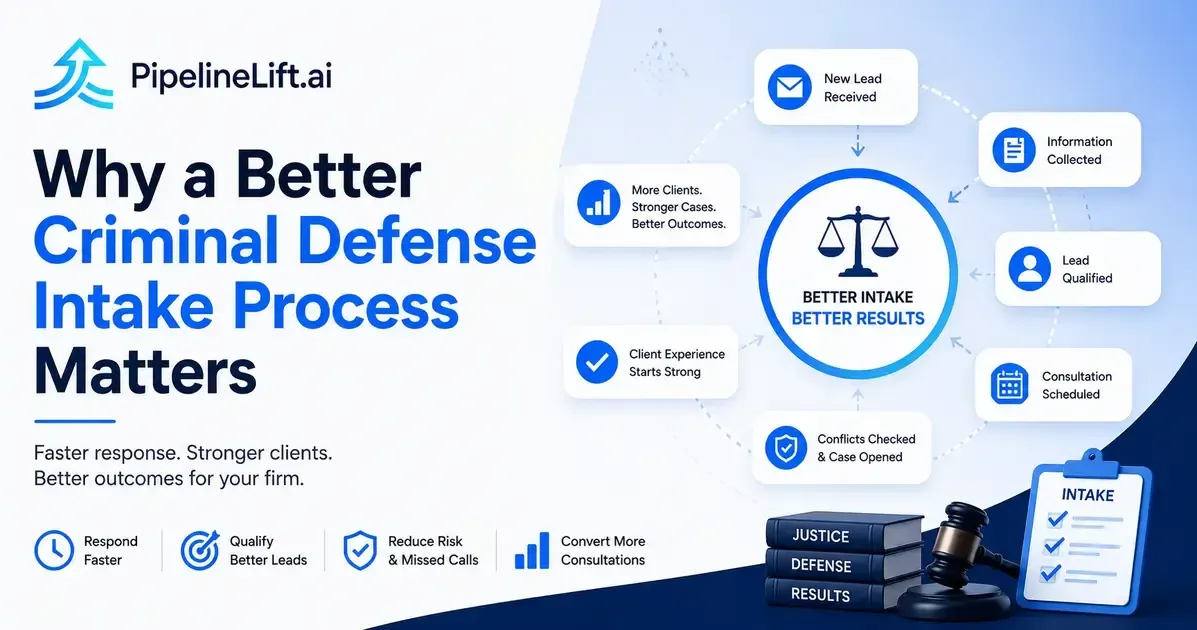
Why a Better Criminal Defense Intake Process Matters?
A criminal defense intake process is more than a form or phone script. It is the operational system that determines how quickly a law firm receives an inquiry, identifies urgency, collects the information needed for screening, follows up, and moves an appropriate prospective client to the next step.
That matters because criminal defense inquiries can arrive under pressure. A caller may be dealing with an arrest, an upcoming court appearance, a family member in custody, or uncertainty about what happens next. If the intake workflow is slow or inconsistent, the firm can lose the opportunity before an attorney has a meaningful chance to review it.
A Criminal Defense Intake Process Must Identify Urgency Early
Criminal defense intake should surface the facts that affect routing and timing without turning intake into legal analysis. Current criminal-defense intake guidance commonly emphasizes contact details, general charge or matter type, jurisdiction, custody status, court dates, existing representation, and conflict-relevant parties.
A useful workflow may capture:
Name and preferred contact method.
General charge or reason for seeking counsel.
Relevant city, county, court, or jurisdiction.
Current custody status.
Known court or hearing dates.
Existing representation.
Names needed for conflict screening.
The next action and person responsible.
The purpose is operational. The intake team needs enough information to determine where the inquiry should go, what needs prompt human attention, and whether the matter appears to fit the firm's criteria.
The Legal Intake Process Should Separate Screening From Legal Advice
Intake should collect and route information, not make legal judgments for an attorney. That distinction is important in criminal defense, where callers may want immediate advice about police contact, charges, defenses, likely outcomes, or what they should do next.
A strong system creates a clear boundary. Defined questions can support qualification and scheduling, while issues requiring legal judgment move to the firm's lawyers.
“Duties to a prospective client can attach earlier than most firms think — often on that first stressed-out phone call. A criminal defense intake process needs to move fast, but it also needs to know exactly where the line is between gathering facts and giving legal advice.”
Kathryn Honecker, JD, Creighton University School of Law (Cum Laude) — 20+ years litigating class actions and complex disputes; named to Arizona's “Top 100 Trial Lawyers”
Law firms should also consider professional-responsibility duties that can arise before representation begins. ABA Model Rule 1.18 addresses duties to prospective clients and restricts the use or disclosure of information learned from qualifying consultations even when no attorney-client relationship follows. Firms should evaluate the rules and guidance applicable in their jurisdiction and configure intake accordingly.
Fast Response and Follow-up Protect Existing Demand
Criminal defense firms may already be paying for Google Ads, SEO, directories, referrals, and other acquisition channels. More lead generation does not repair a process that lets existing inquiries sit unanswered or disappear after one missed connection.
The better question is what happens after the inquiry arrives.
A criminal defense intake workflow should define how the firm responds to calls, web forms, texts, and other inquiries during business hours and after hours. It should also define what happens after a missed call, an unanswered callback, or an inquiry that needs additional follow-up.
Lead generation creates the opportunity. Intake determines whether the firm responds, qualifies, follows up, and moves that opportunity forward consistently. For a broader framework, see PipelineLift AI's legal intake guide and its discussion of the difference between acquisition and intake conversion.
Repeatable Workflows Make Attorney Handoffs More Reliable
A prospective client should not have to restart the conversation every time the inquiry moves from one person to another. Intake records should give the attorney or designated team member enough context to understand why the person contacted the firm and what has already happened.
A repeatable handoff can include the inquiry source, contact history, key screening information, urgency flags, scheduled next step, and any documents already received. The goal is not to conduct the criminal defense investigation during intake. It is to create a clean operational record that supports attorney review.
Consistency also makes intake easier to evaluate. Firm leaders can examine where inquiries stop moving, whether callbacks are delayed, whether after-hours contacts receive attention, and whether qualified opportunities reach the intended next step.
Intake Is Different From the Criminal Case Process
The criminal defense intake process is the law firm's front-end workflow for receiving and screening an inquiry. It is not the criminal process itself, the criminal case process in a particular jurisdiction, or the prison intake process used by correctional institutions.
It is also not a substitute for a criminal defense investigation. Intake can collect basic information and route the matter, while legal strategy, investigation, and advice remain with the firm's attorneys and appropriately supervised legal team.
Keeping these functions separate helps the firm focus intake on its actual purpose: moving the right inquiry to the right next step with appropriate information, safeguards, and responsibility.
Pipelinelift AI Supports Intake and Conversion Infrastructure
PipelineLift AI is intake and conversion infrastructure built for law firms. Its intake capabilities can support engagement through AI voice agents, SMS, email, and web chat, along with missed-call recovery, qualification, follow-up, and routing qualified inquiries toward the next step.
For a criminal defense practice, those capabilities can address operational gaps such as after-hours inquiries, missed calls, inconsistent follow-up, and delays before a qualified opportunity reaches the firm's team. PipelineLift AI is designed to complement human staff, not replace attorney judgment.
Firms can review PipelineLift AI's intake and follow-up services to see how the platform approaches these parts of the intake workflow.
A Pipeline Audit™ can also help a firm examine its existing intake pipeline for potential leakage or conversion gaps before increasing acquisition spend.
Conclusion
A better criminal defense intake process gives a law firm more control over what happens between a new inquiry and the next meaningful step. It helps identify urgency, collect the right information, maintain follow-up, and hand qualified opportunities to the right person without treating intake as legal advice.
For growing firms, the next growth opportunity may already be inside the existing inquiry pipeline. Before buying more traffic, it is worth examining whether response, qualification, follow-up, and handoff are working as intended.
If your firm is generating criminal defense inquiries but is unsure where opportunities are being lost, request a Pipeline Audit™ from PipelineLift AI to examine the intake process before increasing lead-generation spend.
Frequently Asked Questions
What is a criminal defense intake process?
A criminal defense intake process is the workflow a law firm uses to receive, screen, qualify, and route inquiries from people seeking criminal defense representation. It can cover first response, basic information capture, conflict-related screening, urgency identification, follow-up, and the next step.
What information should criminal defense intake collect?
The exact fields should reflect the firm's practice and jurisdiction. Common operational information includes contact details, general matter type, jurisdiction, custody status, known court dates, existing representation, conflict-relevant names, and preferred contact method.
Does intake software replace a criminal defense lawyer?
No. Intake technology can support defined tasks such as first response, information capture, qualification, scheduling, and follow-up. Legal advice, legal judgment, representation decisions, and defense strategy remain attorney responsibilities.
Can criminal defense intake operate after hours?
Yes. Technology can support initial engagement outside normal office hours. Firms should still define when an inquiry requires human escalation and how attorneys or staff take control when appropriate.
Disclaimer: This article is for educational purposes only and does not constitute legal advice. Nothing in this article creates an attorney-client relationship.
Kathryn Honecker is a member of PipelineLift AI's Founding Legal Advisory Council and is an equity holder in PipelineLift AI.

