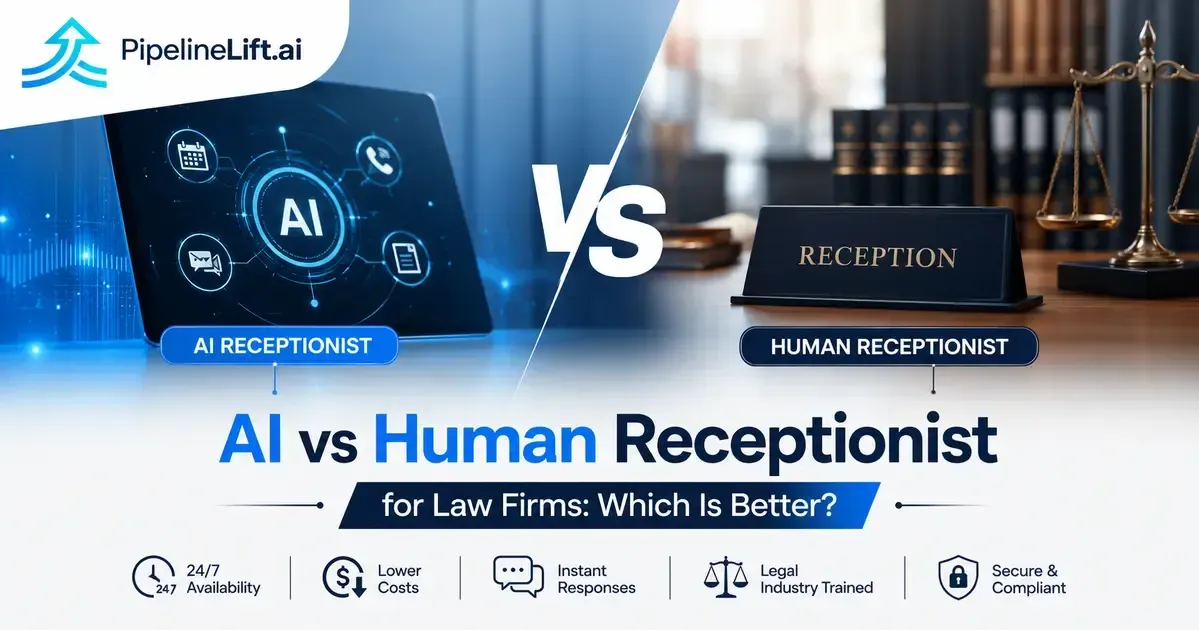
AI vs Human Receptionist for Law Firms: Which Is Better?
For a law firm comparing an AI vs. human receptionist model, the best answer is rarely that one should completely replace the other. AI is strongest at fast, repeatable intake work and extended coverage. People remain stronger when a conversation requires empathy, discretion, or judgment.
The real decision is how to divide intake work so every inquiry has a clear next step. A firm can spend heavily on Google Ads, SEO, referrals, or directories and still lose opportunities if calls go unanswered, follow-up breaks down, or qualified inquiries never reach the right person.
AI Receptionists and Human Receptionists Solve Different Intake Problems
A human receptionist can read emotional cues, adapt to unusual situations, coordinate with attorneys, and change direction when a caller does not fit a standard workflow. Those strengths matter in legal intake, where prospective clients may be distressed, confused, or dealing with sensitive facts.
AI receptionists are better suited to defined tasks such as initial response, information capture, approved qualification questions, routing, missed-call recovery, and follow-up. Their value is not that they imitate a lawyer or eliminate the intake team. Their value is consistent execution of work that can be clearly defined.
AI Receptionists Can Provide Broader Coverage
Coverage is one of the clearest differences. Human receptionists work scheduled hours and have finite capacity. An AI-supported intake system can continue engaging inquiries when the office is closed or staff members are occupied.
Clio's 2024 secret-shopper study contacted 500 law firms and found that 48% were effectively unreachable by phone, even after shoppers gave firms an opportunity to respond to messages. Only 40% answered the initial call. Clio reported these findings as part of its 2024 Legal Trends research.
For a firm already paying to create demand, an unanswered inquiry is not only a reception problem. It is a conversion problem. The next growth opportunity may already be inside the firm's existing inquiry pipeline.
Human Receptionists Are Better for Nuance and Relationship Handling
Speed matters, but it is not the only standard for a good intake experience. A caller discussing an arrest, injury, family conflict, or another stressful matter may need a person who can recognize emotion, change tone, and decide when to involve an attorney or senior intake professional.
Human staff also remain important when a conversation requires discretion or falls outside approved intake criteria. AI should support defined intake tasks, not make legal judgments or provide legal advice.
That makes escalation design critical. Firms evaluating receptionist AI should decide what the system may ask, what it must avoid, and which situations require an immediate human handoff.
“The firms that get this right treat it as a contract and workflow decision, not just a technology choice — they define escalation triggers up front instead of discovering them the hard way, on a live call.”
Brian Heller, JD, Boston University; MBA, University of Michigan — 20+ years in corporate law and business development; led $1B+ in annual deal negotiations
Cost Should Be Measured Against Coverage and Intake Quality
AI and human reception models have different cost structures. Software can involve implementation and usage costs. Human staffing involves compensation plus recruiting, training, management, leave coverage, and other operating costs.
For managing partners, the useful comparison is not simply monthly software cost versus salary. It is the cost of creating reliable intake coverage without sacrificing caller experience, qualification quality, or human control.
A lower-cost system is not valuable if it creates poor handoffs or weak intake. A capable employee may still leave coverage gaps if the firm needs response outside staffed hours. The right model depends on the firm's inquiry volume, workflow, and service expectations.
A Hybrid Model Often Fits Growing Law Firms Best
Many firms do not need an all-human or all-AI model.
Intake task | AI role | Human role |
First response | Immediate engagement | Available when staffed |
Routine information capture | Consistent and structured | Handles exceptions |
After-hours inquiries | Maintains coverage | Receives escalations |
Follow-up | Repeats approved outreach | Takes over when needed |
Sensitive conversations | Escalates | Provides empathy and discretion |
Legal judgment | Not appropriate | Attorney responsibility |
This model can complement an existing intake team rather than replace it. Automation takes on repetitive and time-sensitive work, while people focus on conversations and decisions where human involvement adds the most value.
Law Firms Need Clear Oversight for AI Intake
The American Bar Association issued Formal Opinion 512 on July 29, 2024, addressing lawyers' use of generative AI and discussing duties involving competence, confidentiality, communication, supervision, and fees.
Formal Opinion 512 is not specifically about AI receptionists, and applicable obligations can vary by jurisdiction and implementation. Still, its core principle is relevant: lawyers using AI tools should understand their capabilities and limitations and remain responsible for meeting professional obligations.
Firms should examine what information an intake system receives, what the system is permitted to say, how escalation works, and how staff can intervene when necessary. Firms should also evaluate applicable professional-responsibility requirements in their jurisdiction.
The Right Choice Depends on the Intake Failure You Need to Fix
A human-first model may fit firms with substantial walk-in activity, highly sensitive calls, complex front-desk responsibilities, or enough staffing to maintain the desired coverage.
An AI-first model may fit firms whose main problems are missed calls, after-hours inquiries, repetitive qualification, or inconsistent follow-up. A hybrid model may fit firms that want immediate response and persistent follow-up while keeping people in control of nuanced conversations.
Before choosing, review the intake workflow. Identify when inquiries go unanswered, what happens after missed calls, how quickly digital inquiries receive a response, which qualification questions are repeatable, and where human handoffs are required.
Where PipelineLift AI Fits Into Legal Intake?
PipelineLift AI is intake and conversion infrastructure for growing law firms. It is not positioned as a generic receptionist replacement. Its role begins when an inquiry enters the firm's pipeline.
PipelineLift AI can support initial engagement across voice, SMS, email, and web chat, along with intelligent qualification, persistent follow-up, missed-call recovery, and workflow integrations. The firm's team remains important and can take control when human involvement is appropriate.
For more context, review the PipelineLift AI legal intake guide and services overview to see how response, qualification, follow-up, and handoff fit into a broader intake process.
Conclusion
The AI vs human receptionist law firm decision is best treated as an intake-design question. AI can support speed, coverage, qualification, and follow-up. People provide judgment, empathy, and control where those qualities matter most.
Before increasing lead-generation spend, examine what happens to the inquiries already entering the firm. A Pipeline Audit™ can help identify response, follow-up, and handoff gaps so the firm can decide where automation and human involvement should fit. Schedule a Pipeline Audit™
Frequently Asked Questions (FAQs)
Is an AI receptionist better than a human receptionist for a law firm?
AI is better for some tasks, not every task. It is well suited to fast, repeatable responses and extended coverage. Humans are stronger when empathy, judgment, discretion, or unusual circumstances matter.
Can an AI receptionist replace a law firm intake team?
It should not be assumed to replace the team. AI can support initial response, qualification, follow-up, and routine communication while staff focus on matters requiring human involvement.
Can AI receptionists handle after-hours calls?
AI-supported intake can provide after-hours engagement when staff is unavailable. Firms should still create clear escalation rules for urgent, sensitive, or complex matters.
What should a law firm compare before choosing receptionist AI?
Compare coverage, qualification logic, escalation, human handoff, workflow compatibility, implementation requirements, reporting, and the controls available to the firm. Voice quality alone is not enough.
Are there ethics issues with AI intake?
Potential issues depend on the technology, information involved, workflow, and jurisdiction. Firms should evaluate applicable professional-responsibility requirements, confidentiality, supervision, and vendor practices before implementation.
Disclaimer: This article is for educational purposes only and does not constitute legal advice. Nothing in this article creates an attorney-client relationship.
Brian Heller is a member of PipelineLift AI's Founding Legal Advisory Council and is an equity holder in PipelineLift AI.

