
Why Law Firms Lose Leads Before the First Call
Most law firms that feel like they're not growing fast enough respond by spending more on marketing — more ads, more SEO, more referral development. In the majority of cases, that's treating the wrong symptom. The firm doesn't have a shortage of people asking for help. It has a shortage of those inquiries turning into signed clients. That's a conversion problem, not a lead generation problem, and no amount of additional marketing spend fixes it.
The Assumption Most Firms Make
When growth stalls, the instinctive move is to generate more inquiries. It feels productive, it's measurable, and it's the lever every marketing vendor is built to pull. But more leads only help if the firm can actually convert a meaningfully higher number of them into clients. If intake is already losing a large share of qualified prospects, adding more leads to that same leaky process just means losing more of them — at a higher cost.
This is easy to miss because lead volume is visible and conversion loss usually isn't. A firm can see exactly how many clicks an ad campaign generated. Very few firms can tell you, with the same precision, how many of last month's inquiries were never actually contacted, how many sat unanswered overnight, or how many went cold after a single follow-up attempt.
What "Conversion Problem" Actually Means
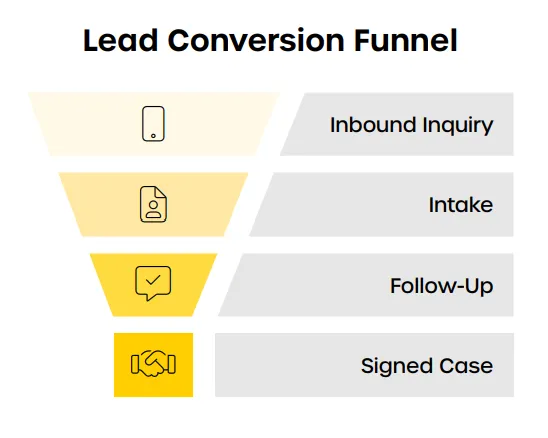
Growth happens across three distinct stages, and most firms only measure the first and the last:
Leads — every inbound inquiry, regardless of quality: a call, a form, a chat message, a referral.
Case Opportunity Intakes (COIs) — leads that have actually been contacted, checked against the firm's own case criteria, and moved to a next step, like a scheduled consultation.
Signed clients — COIs the firm successfully converted into a retained matter.
A conversion problem shows up as a large drop-off between leads and COIs — meaning a firm is generating real demand but losing much of it before it's ever properly engaged. A lead generation problem, by contrast, would show up as simply not having enough inbound inquiries in the first place. Most firms that feel stuck are dealing with the first situation, not the second, even though the second is the one marketing spend is built to solve.
The Evidence for Where the Loss Actually Happens
Independent research on legal intake consistently points to what happens after the inquiry arrives, not before it:
A widely cited MIT and InsideSales.com study found leads contacted within 5 minutes are roughly 21 times more likely to convert than those contacted 30 minutes later.
Hennessey Digital's 2025 study of over 1,300 law firms found the median response time to an online lead was 13 minutes, with only 25% of firms responding within 5 minutes, and 26% never responding at all.
An ABA Law Practice study found that 42% of law firms take three or more days to reply to a voicemail or online inquiry.
None of these numbers describe a lead shortage. They describe a large, measurable gap between the moment someone reaches out and the moment a firm actually engages them — and that gap is where most of the "missing growth" a firm feels is actually going.
Why This Distinction Changes What a Firm Should Do Next
If the real issue is conversion, then increasing marketing spend doesn't fix it — it just increases the volume flowing through the same leaky process, at greater cost. The higher-leverage move is almost always to fix what happens between "inquiry received" and "consultation scheduled" first, then scale marketing spend once the firm knows a much higher share of what it generates will actually convert.
This isn't an argument against marketing. It's an argument about sequencing: spend more on generating leads once the firm is confident it can convert a strong share of them, not before.
How to Tell Which Problem Your Firm Actually Has
A few questions tend to make this clear quickly:
Do you know your firm's actual lead-to-COI conversion rate, or only your lead volume?
Can you say with confidence how quickly your firm responds to a new inquiry, across every channel — phone, web form, chat, and text?
Do you know how many inquiries went unanswered or unreturned last month?
Is your intake process consistent regardless of who happens to answer, or does it vary by staff member and time of day?
If those numbers aren't readily available, that's itself a signal. Firms with a genuine lead generation problem usually know it, because inbound volume is simply low. Firms with a conversion problem often don't know it, because the loss happens quietly, in gaps that never show up on a marketing dashboard.
Frequently Asked Questions
Could a firm have both problems at once? Yes — it's possible to have both weak lead volume and weak conversion. In practice, most firms that assume they have a lead problem turn out to have a conversion problem once they actually measure response time and follow-up consistency.
Isn't more marketing spend the safer bet if you're not sure which problem you have? Not necessarily. Spending more into a process with a real conversion gap increases the total dollars lost to that gap, rather than fixing it.
How would a firm find out which problem it actually has? Measuring response time, missed-call rate, and lead-to-COI conversion rate — typically through reviewing existing intake data or a structured audit of the process — makes the answer clear fairly quickly.
Does this apply equally across personal injury, family law, and criminal defense? The underlying dynamic is the same across practice areas — slow or inconsistent intake costs opportunity — though the specific stakes and timelines differ by case type.
Not sure which problem your firm actually has? A Pipeline Audit™ shows your actual lead-to-COI conversion rate and exactly where the gap is happening — before you spend another dollar on more marketing.

