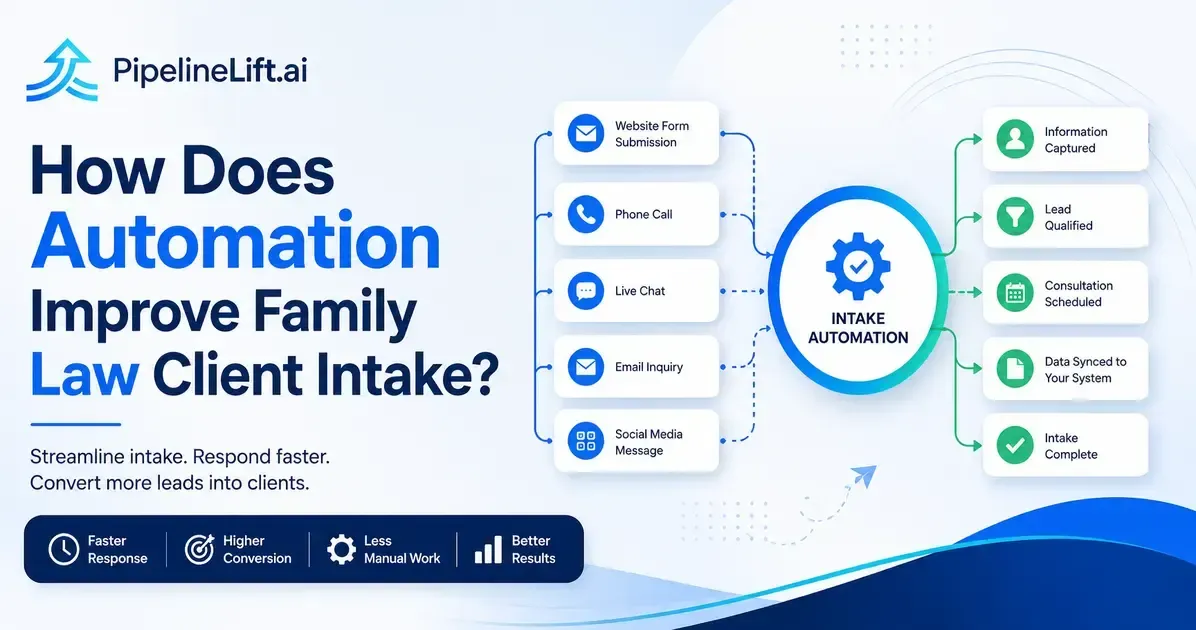
How Automation Improves Family Law Client Intake?
Family law client intake often starts when a prospective client is dealing with a stressful personal situation. The firm still needs to be quick and efficient, gather valuable data, determine fit or conflict problems, and forward relevant questions to the next level without being impersonal.
Automation can help with that work when it is centered around the firm's intake process. It is particularly effective for tasks that are repeated, like first response, structured information collection, reminders, qualification support, scheduling, and routing.
How Does Family Law Client Intake Benefit From Automation?
Family law intake may involve details of the parties, children, history of the relationship, any ongoing proceedings, finances, safety issues, and the immediate goal of the prospective client.
Current family law intake guidance also focuses on gathering sufficient information for screening and for preparing for consultation, but not necessarily on the first form being case development.
That translates to a real-life conflict. The firm must have value-added information, but a lengthy static questionnaire can be onerous on the individual filling it out. The intake path can vary depending on previous answers; for example, a divorce inquiry, custody inquiry, and adoption inquiry will not receive the same questions.
1. Automation Improves the First Response
An automated workflow can recognize an inquiry and initiate the next step in the intake process, regardless of whether a staff member sees a voicemail, email, or web form.
A configured system can confirm receipt, collect basic information, and direct the potential client to the next step via phone, SMS, email, or web chat. It should also provide an indication of when a person should take over.
What's important is that law firm client intake is a process. Continuity is important between the various stages of legal intake, which typically include initial contact, information collection, follow-up, consultation, and onboarding.
2. A Family Law Client Intake Form Should Adapt to the Matter
A family law client intake form should not ask for all of the facts that may be relevant at some later time, but instead should ask for the information that the firm needs for the next decision.
Conditional logic allows you to show different questions depending on the type of matter and answers to previous questions. This is a typical approach to creating dynamic legal intake forms to avoid having irrelevant questions in the prospect's way.
A family law intake form can start with general contact and case information and then include a list of the various steps involved in divorce, custody, support, adoption, or another category that the firm has established.
Automation can also identify responses that need to be dealt with more quickly by a human. This renders the workflow more helpful without making legal decisions to the technology.
3. Qualification and Routing Become More Consistent
The firm needs to have established intake criteria for automation to work best.
As a growing firm, you can set up policies on matter type, jurisdiction, conflict screening procedures, consultation requirements, and more firm-specific considerations. The system can then gather information that is relevant and do so in a consistent order, and route the inquiry appropriately. The structured and repeatable intake processes also help to identify operational bottlenecks.
PipelineLift AI has a particular opportunity definition that is beyond the initial inquiry.
Case Opportunity Intake (COI): Lead contacted, qualified, and moved to next step.
A qualified opportunity is not a requirement for an inquiry. Intake infrastructure should enable the firm to determine whether it's a matter that's ready to move forward or needs initial contact.
4. Follow-Up Does Not Have to Depend on Memory
A prospective client could lose a call halfway through a form or require more time before scheduling.
Automation can be used to help with follow-up via predetermined SMS or email sequences, reminders, and missed call recovery. It's important for family law firms to keep the tone calm, clear, and relevant to the context. The next step should be easy and not pressure the prospect with follow-up!
This is where automation can fill in the gaps to an already existing intake team. Staff can save time on repetitive outbound interactions and focus more on human interactions where they will be more effective.
5. Human Oversight Still Matters
It is important for law firms implementing AI in intake to set up proper oversight.
The Formal Opinion 512 (2024) from the American Bar Association (ABA) outlines several professional duties that attorneys need to take into account when employing generative AI tools, such as competence, confidentiality, communication, and supervision.
When it comes to intake, firms need to establish what automation can do, what information it can process, when there's a need for a human touch, and how the system will be evaluated.
“Family law intake sits at the intersection of AI capability and human judgment. The ABA's guidance on supervising these tools isn't a checkbox — firms need a real answer for when and how a person steps in, especially on matters this personal.”
Michael Carey, JD, Harvard Law School — 250+ AI patent matters for Fortune 50 companies; former U.S. Air Force Judge Advocate & Major
Requirements for professional responsibility may be different in different jurisdictions and implementations, so companies should consider what requirements may apply.
AI can help with specific intake tasks, but should not be used to make legal decisions for lawyers.
Where PipelineLift AI Fits Into Family Law Intake?
PipelineLift AI is an intake & conversion infrastructure for law firms. It can be used for initial engagement via AI voice agents, SMS, email, and web chat, qualification, follow-up, missed call recovery, and workflow functions.
It starts to play its role when an inquiry is put into the firm's pipeline. If a company already has a budget for Google Ads, SEO, referrals, or any other acquisition efforts, it does make a difference.
The more leads you generate, the more you will have to respond to, qualify, and follow up with.
A good starting point is to plot the process of how enquiries are received, the time to respond, the information that is gathered, the follow-up process, and where qualified enquiries are passed to.
See the PipelineLift AI legal intake guide for a more general overview. Companies considering the intake channels at their disposal can also check out PipelineLift AI services.
Conclusion
Using automation can help make client intake more consistent for family law firms, from responding to inquiries, collecting information, qualifying clients, providing follow-up, and passing them along. The objective isn't to take out individuals. It is to create a reliable process for the work that occurs prior to the qualified opportunity getting to the right person.
As a family law firm grows, before it starts to ramp up the dollars spent on acquisition, it should know what is occurring with the inquiries it already receives. Before a firm increases the amount of lead volume they're bringing in, a Pipeline Audit™ can help review the intake process for any response, follow-up, missed-call, and conversion gaps. Schedule a PipelineLift AI intake assessment.
Frequently Asked Questions (FAQs)
What is family law client intake?
Family law client intake is the process of receiving a potential client's inquiry, gathering initial data, screening the case based on firm criteria, following up, and taking a potential client inquiry to the next step.
Can a family law client intake form be automated?
Yes. Firms can automate conditional questions, reminders, routing, and follow-up, while retaining human review for matters that need a judgment and/or escalation.
Does automation mean that the intake team is being replaced?
No, automation is more appropriate for well-defined and repetitive tasks. There will still be a need for human workers to handle delicate discussions, decision-making, escalation, and building relationships.
Can automation support after-hours inquiries?
Yes. An intake system can be set up to start initial engagement outside of business hours, gather some basic information, and forward it based on the firm's guidelines. Human escalation procedures should be put in place for situations that need to be dealt with directly.
What should a firm review before automating intake?
Begin by working on the current workflow. Discuss the channels of inquiry, response protocols, screening questions, handoff protocols, follow-up protocols, and circumstances that necessitate immediate human intervention. Technology should be set up based on those decisions.
Disclaimer: This article is for educational purposes only and does not constitute legal advice. Nothing in this article creates an attorney-client relationship.
Michael Carey is a member of PipelineLift AI's Founding Legal Advisory Council and is an equity holder in PipelineLift AI.

