

What Is Law Firm Lead Response Time and Speed? Statistics
A potential client contacting a law firm is not the same as creating a new client opportunity. The difference often depends on what happens after the inquiry arrives. Law firm lead response time refers to how quickly a firm responds after receiving a new inquiry through channels such as phone calls, website forms, or online messages.
For growing firms investing in Google Ads, SEO, referrals, and other acquisition channels, the first response is a critical part of the intake process. A firm may generate steady law firm leads but still lose valuable opportunities when response is delayed, follow-up is inconsistent, or inquiries are not properly qualified.
The central issue is often not simply generating more leads. Many firms need to understand how effectively they convert the inquiries already entering their pipeline.
Research on lead response time shows that speed can affect opportunities to contact and qualify leads. However, firms should apply these findings carefully because many studies measure broader sales environments rather than law firms specifically. For example, InsideSales research with MIT Professor James Oldroyd found that response timing affected contact and qualification outcomes in the companies studied.
Why Law Firm Lead Response Time Matters
When someone contacts a law firm, they are usually looking for guidance during an important moment. They may be comparing multiple firms, deciding whether to schedule a consultation, or determining which attorney they trust.
A slow response can create uncertainty. Even when the firm has strong legal experience, delayed communication may prevent the intake process from moving forward.
According to Hennessey Digital's 2023 Lead Form Response Time Study, which examined law firm responses to online inquiries, 18% of firms responded within five minutes and 56% of responding firms responded within two hours.
The practical lesson is not that every inquiry must follow the exact same timeline. The lesson is that firms should know their own response time and understand where delays occur.
A firm that does not track:
When inquiries arrive.
How quickly someone responds.
Whether follow-up occurs.
How many inquiries move forward.
You may not know where potential opportunities are being lost.
“Firms often underestimate what inconsistent intake actually costs them — not just in lost signups, but in the exposure that comes with an ad hoc, undocumented process. Automation done right doesn't just close the ROI gap, it creates the kind of consistent, defensible workflow that holds up under scrutiny.”
Kathryn Honecker, JD, Creighton University School of Law (Cum Laude) — 20+ years litigating class actions and complex disputes; named to Arizona's “Top 100 Trial Lawyers”
The Difference Between Lead Generation and Lead Conversion
Many law firms focus heavily on acquiring more traffic, more advertising visibility, and more online inquiries. Those activities can create opportunities, but they do not automatically create qualified matters.
Lead generation creates inquiries. Intake determines how many of those inquiries become meaningful opportunities.
This distinction is important because increasing marketing spend may not solve an intake problem. If a firm's existing workflow has slow response, missed calls, weak follow-up, or inconsistent qualification, additional inquiry volume may simply create more opportunities that are not fully captured.
PipelineLift AI discusses this broader issue in its article about why conversion problems can exist even when firms are generating leads.
What Research Says About Speed to Lead?
The phrase "speed to lead" describes the time between receiving an inquiry and making the first response.
Research from InsideSales examined inbound lead response behavior and found that faster responses were associated with stronger contact and qualification outcomes in the businesses studied. The research reported that contacting leads within five minutes produced significantly different outcomes compared with waiting longer periods.
Hennessey Digital published its 2025 Lead Form Response Time Study on June 24, 2025. The research contacted 1,333 U.S. law firms during the first quarter of 2025, using website lead forms to measure the time between submitting an inquiry and receiving the first personal outreach.
The study sampled personal injury, criminal defense, and other law firms. Its findings offer a practical benchmark for evaluating online lead response.
According to the 2025 Lead Form Response Time Study, the results included the following:
Response Time Measure | 2025 Finding |
Median response time | 13 minutes |
Firms responding within 5 minutes | 25% |
Firms responding within 10 minutes | 33% |
Firms responding within 1 hour | 56% |
Firms taking more than 2 hours or not responding within the study's seven-day window | 39% |
Firms responding within 7 days | 74% |
Firms not responding within 7 days | 26% |
These statistics show that substantial response gaps remain. The median of 13 minutes provides a useful point of comparison, while the percentage of firms that took more than two hours or failed to respond within seven days highlights the limits of inconsistent intake processes.
The methodology matters. Inquiries were submitted between 10 a.m. and noon in each firm's local time zone. The findings therefore describe responses to business-hours website inquiries rather than a dedicated test of evenings, weekends, or other after-hours periods.
The results should be treated as an industry benchmark, not a guarantee of how quickly every firm should respond or a prediction of conversion rates.
However, law firms should avoid treating general sales statistics as guaranteed legal intake results. A personal injury inquiry, criminal defense inquiry, or family law inquiry may involve different urgency levels and different intake considerations.
The more useful approach is measuring the firm's own intake workflow.
A firm should understand:
How long online leads wait before receiving a response.
How missed calls are handled.
Whether after-hours inquiries receive engagement.
Whether follow-up continues after the first contact attempt.
Whether qualified opportunities reach the correct team member.
4 Common Reasons Law Firms Have Slow Lead Response
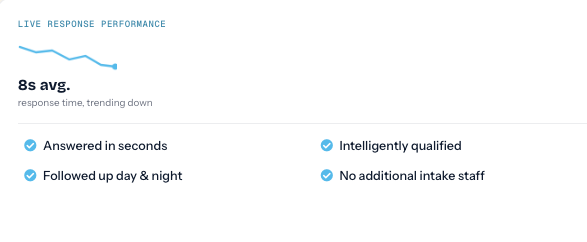
Several operational issues can affect response time.
1. Intake teams may have competing priorities
A law firm intake specialist may manage calls, emails, forms, scheduling, and internal communication at the same time. During busy periods, responding quickly to every inquiry can become difficult.
2. Missed calls may not receive consistent follow-up
A missed call is not automatically a lost opportunity, but the next steps matter. Firms should have a defined process for what happens after voicemail, unanswered calls, or incomplete inquiries.
3. After-hours inquiries may wait too long
Many potential clients do not contact firms only during business hours. Without an after-hours intake workflow, inquiries may remain unanswered until the next business day.
4. Follow-up may stop too early
Some potential clients are not ready to move forward immediately. Consistent follow-up helps firms stay connected while allowing prospects time to decide their next step.
PipelineLift AI explains legal intake workflows and the movement from inquiry to qualified opportunity in its legal intake guide.
How Law Firms Can Improve Lead Response Time?

Improving response time does not require removing human involvement from intake. The goal is to create a more consistent process where technology supports the firm's team.
Firms can begin by reviewing:
1. Response Tracking
Measure the time between inquiry and first contact. Without measurement, firms are relying on assumptions.
2. Clear Intake Workflows
Define what happens after:
A website form submission.
A missed call.
A voicemail.
An after-hours inquiry.
A request for consultation.
3. Multi-channel Follow-up
Different potential clients prefer different communication methods. A structured workflow may include phone communication, SMS, email, and website engagement.
4. Qualification Consistency
Case Opportunity Intake (COI): a lead contacted, qualified, and moved to the next step.
A consistent qualification process helps firms understand which inquiries should move forward and which require additional review.
Where PipelineLift AI Fits Into Law Firm Lead Response
PipelineLift AI is intake and conversion infrastructure for growing law firms. It focuses on what happens after an inquiry enters the firm's pipeline.
The platform can support response, qualification, communication, and follow-up through tools such as AI voice agents, SMS, email, web chat, intelligent qualification, and missed-call recovery.
The purpose is not to replace a firm's judgment or intake team. Instead, PipelineLift AI helps create a structured intake process where appropriate technology supports faster engagement and consistent workflows.
Firms evaluating their current intake performance can start by understanding where opportunities may be lost. A Pipeline Audit™ can help examine potential gaps in response, follow-up, and intake flow before increasing acquisition spending.
Conclusion
Law firm lead response time is not only a measurement of speed. It is a reflection of how effectively a firm manages opportunities after they arrive.
Many firms focus on generating more inquiries, but the next growth opportunity may already exist inside their current intake pipeline. Before increasing marketing spend, firms should understand how quickly they respond, how consistently they follow up, and how effectively inquiries move toward the next step.
PipelineLift AI helps law firms build intake and conversion infrastructure designed around response, qualification, and follow-up. If your firm wants to understand where intake opportunities may be getting lost, a Pipeline Audit™ can help evaluate the current process before making additional acquisition investments.
Frequently Asked Questions (FAQs)
What is law firm lead response time?
Law firm lead response time is the amount of time it takes a law firm to respond after receiving a potential client inquiry through phone, website forms, email, or other communication channels.
How quickly should law firms respond to new leads?
Firms should aim to respond as quickly as practical, while building a workflow that maintains accuracy, appropriate qualification, and human oversight.
Does faster response time increase law firm conversions?
Faster response can improve the opportunity to connect with potential clients, but conversion depends on many factors including qualification, follow-up, legal services offered, and the firm's intake process.
Can AI help law firms respond to inquiries faster?
AI can support defined intake tasks such as initial engagement, communication, qualification support, and follow-up. Firms should maintain appropriate human oversight and escalation processes.
Does PipelineLift AI replace a law firm's intake team?
No. PipelineLift AI is designed as intake and conversion infrastructure that can complement existing teams by supporting consistent communication and workflow processes.
Disclaimer
This article is for educational purposes only and does not constitute legal advice. Nothing in this article creates an attorney-client relationship.
Kathryn Honecker is a member of PipelineLift AI's Founding Legal Advisory Council and is an equity holder in PipelineLift AI.


