
How AI Receptionist for Law Firms Works for Legal Intake?
When a prospective client calls a law firm, answering the phone is only the beginning. The firm still needs to capture the right information, determine what should happen next, follow up when necessary, and move appropriate inquiries to a person who can take over.
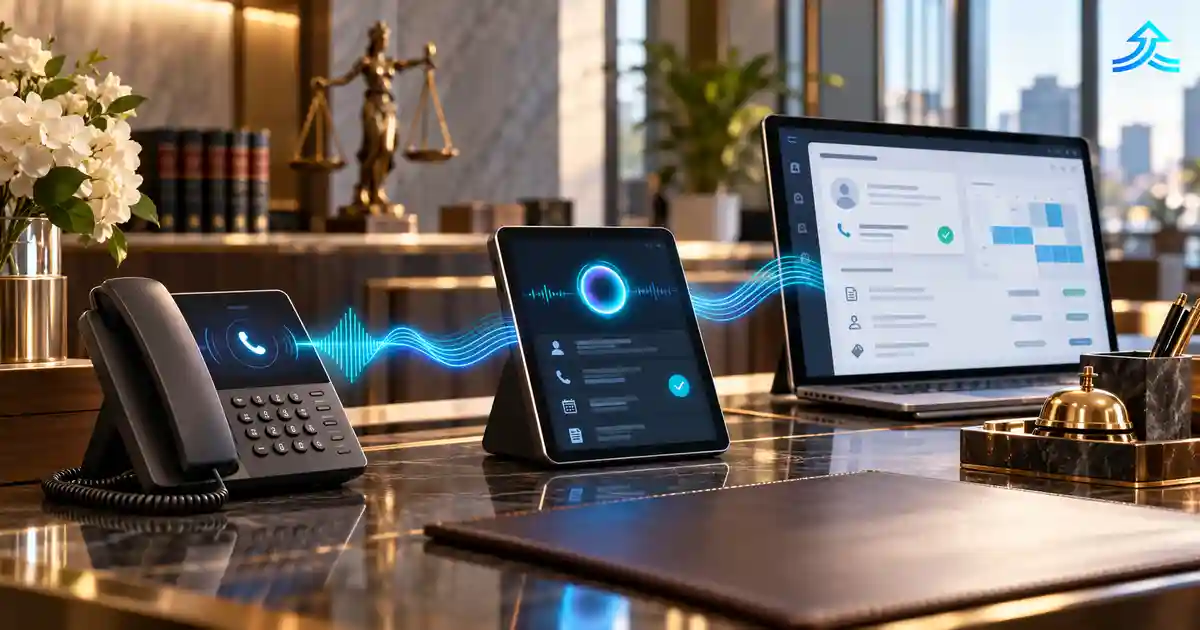
An AI receptionist for law firms can support those early stages of legal intake by answering calls, gathering approved intake information, assisting with qualification, and routing inquiries according to the firm's workflow.
That distinction matters. A law firm does not simply need more calls answered. It needs a reliable process between an inquiry arriving and a qualified opportunity reaching the next step.
What Does an AI Receptionist for Law Firms Actually Do?
The term "AI receptionist" is used broadly. Some products focus primarily on call answering. Others support a wider legal intake process.
In practice, an AI-powered phone intake workflow may be configured to:
Answer incoming or after-hours calls.
Collect a prospective client's contact information.
Ask predefined intake questions.
Identify the general purpose of the call.
Support initial qualification.
Route inquiries according to firm-defined rules.
Escalate situations that require a person.
Trigger SMS or email follow-up.
Record intake information within supported workflows.
The important question is not simply whether AI can answer calls. It is what happens after the call is answered.
For firms reviewing their broader intake process, PipelineLift AI's legal intake guide explains how initial contact, qualification, follow-up, and handoff fit together.
How AI Legal Intake Works From First Call To Handoff?

A well-designed intake workflow gives the AI a defined role rather than asking it to make open-ended decisions.
1. The Inquiry Receives An Initial Response
When a prospective client calls, an AI voice agent can provide an immediate first interaction instead of leaving every inquiry dependent on staff availability.
This can be particularly useful when the intake team is already handling another caller, when a call arrives outside normal office hours, or when the firm has periods of high call volume.
Speed alone is not enough, however. The conversation needs to move somewhere useful.
2. The System Collects Intake Information
The next stage is structured information gathering.
The questions should reflect the firm's actual client intake workflow rather than a generic script. Depending on how the system is configured, an AI agent can collect contact information and other approved intake details needed to determine the appropriate next step.
A good workflow also establishes clear boundaries around what the AI should not attempt to handle. Legal advice and matters requiring professional judgment belong with qualified people at the firm.
3. Qualification Determines What Happens Next
Answering a phone call and qualifying an inquiry are different tasks.
Legal intake qualification involves gathering enough approved information to determine how the inquiry should move through the firm's process. That may mean routing it to an intake specialist, arranging the next step, or identifying that human review is required.
PipelineLift AI defines a Case Opportunity Intake (COI) as a lead contacted, qualified, and moved to the next step.
The goal is therefore not simply a completed conversation. It is a controlled intake process that moves appropriate opportunities forward.
AI Should Complement The Law Firm Intake Specialist
For many firms, the useful comparison is not "human or AI."
An experienced law firm intake specialist can handle sensitive conversations, unusual circumstances, judgment calls, and situations that fall outside a predefined workflow. AI can support the repetitive and availability-sensitive portions of the process.
That can include first response, missed-call recovery, after-hours engagement, initial qualification, and continued follow-up.
Firms considering the operational differences can also review PipelineLift AI's guide to AI versus human reception for law firms.
The objective should be to define where automation belongs and where the firm's people should take control.
“The firms that get this right treat it as a contract and workflow decision, not just a technology choice — they define escalation triggers up front instead of discovering them the hard way, on a live call.”
Brian Heller, JD, Boston University; MBA, University of Michigan — 20+ years in corporate law and business development; led $1B+ in annual deal negotiations
After-Hours Coverage Is Only Useful When The Workflow Continues
Many firms evaluating a virtual receptionist for law firms focus on whether calls can be answered outside business hours.
Coverage matters, but answering is only one stage.
A caller who provides information at night still needs an appropriate next step. The firm should decide in advance what happens after the conversation, including whether the inquiry receives follow-up, enters an existing workflow, waits for staff review, or requires escalation.
The same principle applies to missed calls. A missed phone inquiry should not simply disappear into voicemail without a defined recovery process. PipelineLift AI discusses that broader leakage problem in its article on why law firms lose leads before the first call.
How To Evaluate Multilingual AI Receptionist Support?
Firms searching for the best multilingual AI receptionist for law firms should look beyond the number of languages listed on a product page.
Multilingual intake is an operational workflow. A firm should determine whether the system can conduct the required intake conversation accurately, collect information in the firm's preferred format, follow approved scripts, and transfer the matter appropriately when a person needs to become involved.
Language capability also needs to match the firm's actual client base. A feature has little operational value if the supported workflow does not match how the firm's intake team works.
As with any AI intake system, firms should test real-world scenarios rather than evaluate voice quality alone.
Human Escalation and Oversight Need To Be Designed In Advance
AI intake should operate within defined boundaries.
Before implementation, a law firm should determine which situations can remain automated and which must be routed to a person. Unusual questions, sensitive conversations, unclear requests, or anything requiring legal judgment should have an appropriate escalation path.
This is also an area where professional obligations deserve careful attention. The American Bar Association's Formal Opinion 512, published July 29, 2024, addresses lawyers' use of generative AI and identifies applicable considerations involving competence, confidentiality, communication, and supervision, among other duties. Specific obligations can vary by jurisdiction and implementation.
Firms should evaluate applicable professional-responsibility requirements in their jurisdiction and review their own implementation accordingly.
What To Look For Before Choosing An AI Receptionist?
Rather than choosing a system based on the most impressive demo, law firms should evaluate how the technology fits their actual intake operation.
Important questions include:
What happens when an incoming call cannot be handled normally?
How are missed and after-hours calls treated?
Which intake questions can be configured?
How does qualification work?
When does a human take over?
What follow-up occurs after the first interaction?
Which communication channels are supported?
How does the system fit the firm's existing workflow?
How are multilingual calls handled?
What oversight and escalation procedures are required?
A firm's intake process should be mapped before automating it. Otherwise, technology may simply reproduce an inconsistent process faster.
Where PipelineLift AI Fits Into Legal Intake?
PipelineLift AI is intake and conversion infrastructure for law firms, not an answering service, CRM, or generic virtual receptionist.
The platform can combine AI voice agents with SMS, email, web chat, intelligent qualification, persistent follow-up, missed-call recovery, and workflow integrations. Its role begins after an inquiry enters the firm's pipeline.
That broader focus matters because the underlying problem is often not simply generating more leads. Firms investing in advertising, SEO, referrals, and other acquisition channels also need to understand what happens to the inquiries they already receive.
More acquisition cannot correct a legal intake process that consistently loses opportunities between first contact, qualification, follow-up, and handoff. PipelineLift AI explains this distinction further in why the conversion problem can matter more than the lead generation problem.
Conclusion
An AI receptionist for law firms is most useful when it is treated as part of the legal intake process rather than as a standalone phone feature.
The strongest implementation starts with the firm's workflow: how inquiries are answered, what information is collected, how qualification works, when people take over, and what happens when a prospective client does not immediately move forward.
Before investing in additional traffic or more lead generation, firms with meaningful inquiry volume should understand how effectively their existing pipeline handles the opportunities already arriving.
To see how PipelineLift AI can support voice intake, qualification, follow-up, and human handoff across your firm's workflow, schedule a PipelineLift AI demonstration.
Frequently Asked Questions
What Is An AI Receptionist For Law Firms?
An AI receptionist for law firms is technology that can support incoming phone interactions and defined legal intake tasks. Depending on the system, those tasks can include initial response, information gathering, qualification, routing, and follow-up.
Does An AI Receptionist Replace A Law Firm Intake Team?
It does not need to. AI can support defined and repetitive stages of client intake while the firm's intake professionals handle situations requiring human judgment, sensitivity, or intervention.
Can An AI Receptionist Handle Legal Intake After Hours?
AI voice technology can be used for after-hours engagement when configured for that purpose. The more important consideration is what happens after the call, including qualification, follow-up, escalation, and human review.
Can AI Give Legal Advice During An Intake Call?
PipelineLift AI should not be used to provide legal advice or make legal judgments on behalf of attorneys. Firms should establish boundaries and escalation procedures for questions requiring legal judgment.
Can AI Receptionist Technology Support Multilingual Intake?
Some AI voice systems can support multilingual conversations, but capabilities vary. Firms should confirm the languages, intake workflow, escalation process, and accuracy needed for their specific client population rather than relying solely on broad multilingual claims.
What Is The Difference Between An AI Receptionist and Legal Intake Software?
An AI receptionist commonly refers to technology that handles incoming phone conversations. Legal intake software can cover a wider process that includes response, qualification, follow-up, routing, and other workflow stages. PipelineLift AI operates as intake and conversion infrastructure rather than simply a phone answering tool.
Disclaimer
This article is for educational purposes only and does not constitute legal advice. Nothing in this article creates an attorney-client relationship.
Brian Heller is a member of PipelineLift AI's Founding Legal Advisory Council and is an equity holder in PipelineLift AI.


