

Law Firm Conversion Rate Benchmarks and How to Improve Yours
Law firm conversion rate describes how many people take the next step at each stage of the path to a signed client. Most firms track the first stage: visitors who submit a form or call. Fewer track the second: inquiries that become consultations and retained clients.
Many growing firms already attract enough traffic. Their larger gap often sits after the click, which makes a weak law firm conversion rate more of a conversion problem than a lead generation problem. This article covers current benchmarks, the techniques that move each stage, and how to measure both.
What A Law Firm Conversion Rate Actually Measures
A conversion rate is the percentage of people who complete a desired action compared with the total number of people who had the opportunity to take that action.
For a law firm, the measurement depends on the stage being evaluated.
Examples include:
Website visitors who submit a contact form.
Prospective clients who call the firm.
Inquiries that become consultations.
Qualified inquiries that move to the next intake step.
Consultations that become signed matters.
Because there are multiple stages, there is not one single law firm conversion rate that explains the entire client acquisition process.
A firm website conversion rate may show how well a website captures attention. An intake conversion rate shows how effectively the firm handles inquiries after contact begins.
Both matter.
A Law Firm Conversion Rate Measures Two Separate Stages
Website conversion rate equals conversions divided by unique visitors, multiplied by 100. Client conversion rate uses the same math, with inquiries as the starting point and signed clients as the result. Track the two separately, because different teams and tools influence each number.
The second stage ties to Case Opportunity Intake (COI): a lead contacted, qualified, and moved to the next step. A firm with a strong website rate and few COIs has a gap in intake. Our legal intake glossary defines the terms your team should share.
Why Website Conversion Alone Does Not Tell The Full Story
Law firm conversion rate optimization is often associated with website improvements, landing pages, calls to action, and forms. Those elements matter because the website is often the first point of contact for a prospective client.
Important website conversion factors include:
Clear practice-area messaging.
Simple contact options.
Mobile-friendly experiences.
Relevant landing pages.
Strong trust signals.
Easy paths to request a consultation.
However, website conversion is only one part of the process.
A visitor who submits a form still needs a response. A caller who reaches out still needs appropriate follow-up. A qualified inquiry still needs to reach the correct next step.
This is where law firm intake becomes a critical part of conversion performance.
Benchmarks Show A Wide Spread In Law Firm Website Conversion
Unbounce's 2025 Conversion Benchmark Report puts the median conversion rate for legal landing pages at 6.3%, close to the 6.6% baseline across all industries (Unbounce). Family law matched the legal median, immigration law trailed at 5.6%, and most disability law pages ranged from 0.8% to 21.4%.
Ruler Analytics reported an average legal conversion rate of 7.9% across its tracked sessions, in an analysis published May 29, 2026 (Ruler Analytics). The two figures use different methods, so treat them as a range. Your own trend by practice area and channel matters more than any outside number.
Conversion Optimization Techniques For Law Firm Websites Begin With Mobile And Phone Paths
Unbounce found 88% of legal landing page traffic came from mobile devices, with mobile converting at 21% against 15.9% on desktop. Ruler Analytics found 56.3% of legal conversions happen by phone call. Firms counting only form fills miss over half of their conversions.
Several practical steps follow. Design the mobile page first, place a tap-to-call option near the top, and track calls and chat as conversions. Match page copy to the search terms behind each ad.
Unbounce recommends roughly 600 words for legal landing pages and found college-level reading ease converted best at 7.2%. The spread across reading levels was small, which points to testing over fixed rules.
Law Firm Conversion Rate Optimization Stops Short Of Signed Clients
A page that converts well hands inquiries to a team that must answer them. Clio's 2024 Legal Trends Report tested 500 law firms with a secret shopper inquiry and found 48% unreachable by phone and 33% responding to email (Clio, 2024). Hennessey Digital's 2025 study reported 26% of firms still did not respond to online leads at all (Hennessey Digital, June 2025).
Why law firms lose leads before the first call traces how these losses accumulate. Speed adds to them. A Harvard Business Review analysis of 1.25 million sales leads found firms contacting a lead within an hour were nearly seven times as likely to qualify the lead as firms waiting one more hour (Oldroyd, McElheran, and Elkington, 2011). The data covers sales teams across industries, not law firms.
Our analysis of personal injury firms losing cases after the first call applies the pattern to one practice area.
Conversion Optimization Techniques For Law Firm Websites And Intake Workflows
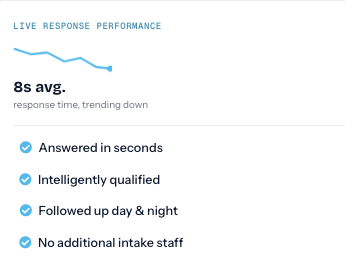
Improving conversion requires looking beyond a single webpage.
Effective law firm conversion rate optimization may involve reviewing:
1. Website Experience
The website should make it easy for prospective clients to understand the firm's services and take the next step.
2. Contact Process
Forms, phone options, and communication channels should create a clear path for someone seeking help.
3. Follow-Up Process
Not every prospective client is ready to move forward immediately. Consistent follow-up can help firms maintain communication with inquiries that need more time.
4. Qualification Process
Firms need a defined method for identifying inquiries that should advance and determining when human attention is required.
PipelineLift AI approaches these challenges as intake and conversion infrastructure for growing law firms. The platform can support AI voice agents, SMS, email, web chat, qualification, follow-up, missed-call recovery, and workflow integrations as part of a firm's intake process.
How To Improve Law Firm Conversion Rate At Both Stages
Report the website rate and the client rate as separate numbers each month. Count forms, calls, and chat in the first. Count consultations booked and clients signed in the second, by practice area.
Set a response target for each channel and track the median reply time along with the share of inquiries never answered. Follow up across phone, text, and email, since a single attempt leaves prospects who miss the first call unreached.
Judge results by cost per signed client, not only cost per lead. True cost per client versus cost per lead shows the calculation. Law firm intake ROI and automation covers how consistent intake changes the math.
Kathryn Honecker, a member of PipelineLift AI's Founding Legal Advisory Council, describes the stakes of an inconsistent process:
“Firms often underestimate what inconsistent intake actually costs them — not just in lost signups, but in the exposure that comes with an ad hoc, undocumented process. Automation done right doesn't just close the ROI gap, it creates the kind of consistent, defensible workflow that holds up under scrutiny.”
Kathryn Honecker, JD, Creighton University School of Law (Cum Laude) — 20+ years litigating class actions and complex disputes; named to Arizona's “Top 100 Trial Lawyers”
Where PipelineLift AI Fits After The Click
PipelineLift AI is intake and conversion infrastructure for law firms. The platform uses AI voice agents, SMS, email, and web chat to respond to inquiries, qualify prospective clients, recover missed calls, and continue follow-up. Your intake team stays in control and steps in when a matter needs human judgment.
The how it works page explains the process. The services page lists each capability, and you will find more about the company there as well.
A Pipeline Audit™ is a pre-purchase assessment of your firm's intake pipeline, designed to identify leakage and conversion gaps before you commit to new technology.
Conclusion
Improving your law firm conversion rate means measuring both stages, closing phone and response gaps, and judging results by signed clients. Before spending more on traffic, examine what happens to the inquiries already entering your firm.
If your firm generates inquiries but cannot say how many are lost between first contact and the next step, a Pipeline Audit™ examines your intake process before you increase lead generation spend.
Frequently Asked Questions
What Is A Good Law Firm Conversion Rate?
Published benchmarks differ by method. Unbounce reports a 6.3% median for legal landing pages, and Ruler Analytics reports a 7.9% average across its tracked legal data. Compare your results against your own trend by practice area and channel.
How Do You Calculate Law Firm Conversion Rate?
Divide conversions by unique visitors and multiply by 100 for the website rate. For the client rate, divide signed clients by inquiries received over the same period.
Is Website Conversion The Same As Client Conversion?
No. Website conversion measures visitors who call, submit a form, or start a chat. Client conversion measures inquiries that become signed clients, and intake handling drives most of that second number.
Does Conversion Rate Optimization Replace Better Intake?
No. Page improvements raise the number of inquiries, while intake determines how many advance to a COI. Our AI legal intake guide explains how firms support the second stage.
Disclaimer:
This article is for educational purposes only and does not constitute legal advice. Nothing in this article creates an attorney-client relationship.
Kathryn Honecker is a member of PipelineLift AI's Founding Legal Advisory Council and is an equity holder in PipelineLift AI.


